


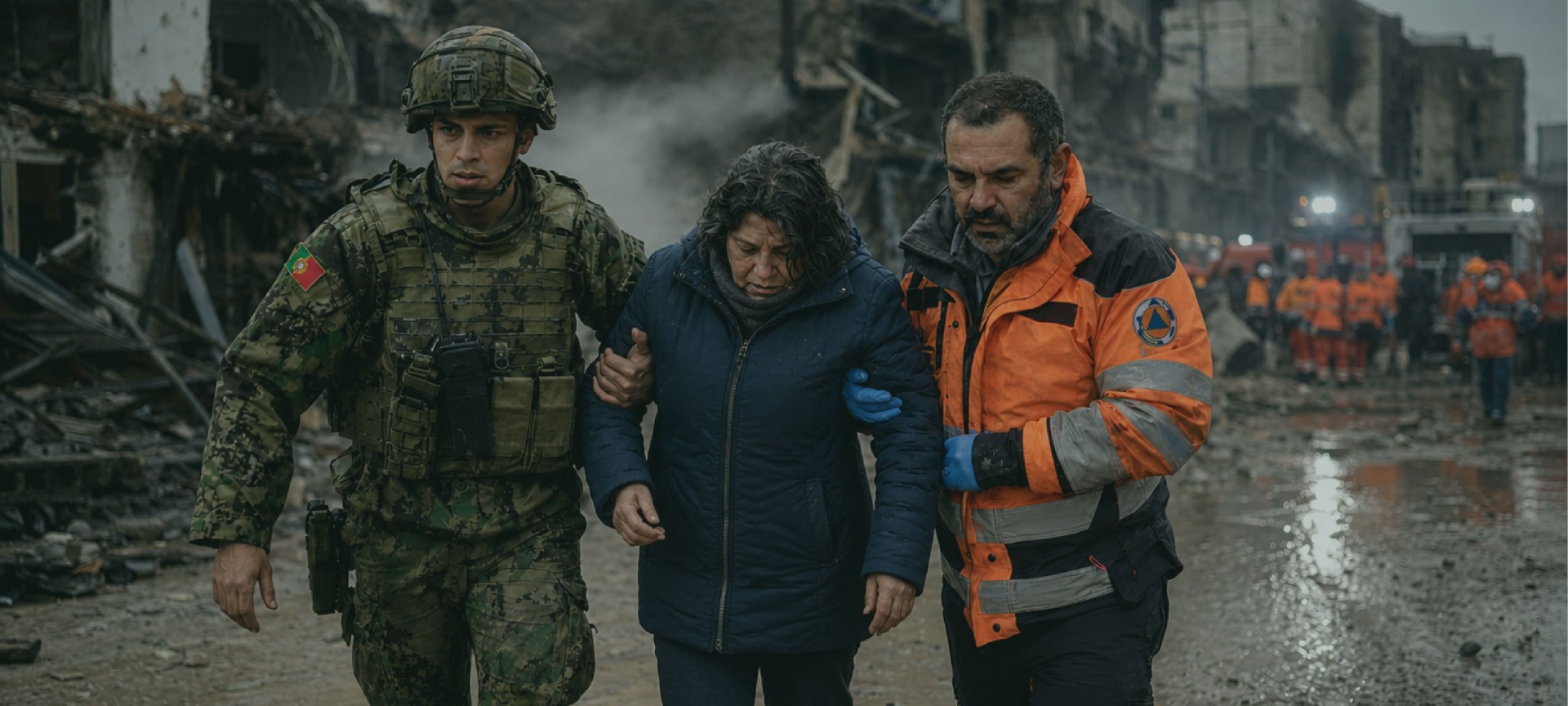
Postgraduation Military Security and Civil Protection: Response to Crisis, Emergency and War Situations
Course formatMixed
Hours150h
Credits12 ECTS
-
1st Edition, Academic Year 2025/2026
1st Edition, Academic Year 2025/2026
Coming SoonStart date 23 Nov, 2026End date 24 Apr, 2027Application start 8 May, 2026Application end 20 Nov, 2026Schedule
Evening classes: on average, three days a week, from 7.00 pm to 11.00 pm.
-
What will I learn in this course?
What will I learn in this course?
Lusófona University ¿ Porto University Centre, through the Civil Protection and Risk Analysis Group (RAGroup Portugal), is offering a postgraduate course in Military Security and Civil Protection, which addresses the risks and opportunities of the Digital Age as a key tool to support the management of crisis response, emergencies and war, aiming to equip professionals and students with skills in the integrated management of security, defence and civil protection, within a global context marked by hybrid threats, technological risks and cyber challenges. This is an academic course with a theoretical and practical component, focused on the study, analysis and application of the principles of security, national defence, civil protection and civil emergency planning.
-
Entry requirements and conditions
Entry requirements and conditions
Security and Information Professionals Emergency Medical Professionals Personnel from the Armed Forces and Security Forces Technicians from Municipal Civil Protection Services Personnel from the National Civil Protection Authority International Relations Technicians Healthcare Professionals Social Security Professionals Students in the field of Civil Protection Students in the field of Security and Information Students in the field of International Relations Students in the field of IT Others interested in the fields of military security, civil protection and civil emergency planning.
-
Technical and professional skills that I will acquire
Technical and professional skills that I will acquire
Knowledge: - Proficiency in the fundamental concepts of security, defence, civil protection and emergency planning. - Knowledge of national and international structures and instruments for responding to crises and conflicts. - Understanding of hybrid, cyber and technological threats and their implications for national security. Skills: - Ability to plan and implement response measures in crisis situations. - Application of risk analysis methodologies and civil emergency planning. - Coordination between civil and military structures in disaster or conflict contexts. Attitudes: - Critical thinking and decision-making ability in contexts of uncertainty. - Valuing inter-institutional cooperation and a culture of collective security. - Ethics and responsibility in the management of sensitive information and in acting in crisis situations. Upon completion, trainees will be equipped to understand, plan and act effectively in emergency and conflict situations, strengthening national resilience and contributing to the protection of the population and the territory in the face of 21st-century threats.
-
Main reasons for choosing this course on ULusófona
Main reasons for choosing this course on ULusófona
- Geopolitics and Cyber Strategy: Main focus: Modern conflicts and spheres of influence. Skills acquired: Analysis of hybrid warfare scenarios and digital influence.
- Monitoring Technologies: Main focus: Satellites, drones and IoT sensors. Skills acquired: Real-time data collection for early warning.
- Cybersecurity and Network Defence: Main focus: Protection of critical infrastructure. Skills acquired: Prevention of attacks on energy, water and healthcare networks.
- Emergency Management and Relief: Main focus: Civil Protection Protocols. Skills acquired: Coordination of resources during natural or technological disasters.
- Crisis Communication and Information Warfare: Main focus: Information management and combating fake news. Skills acquired: Narrative control and public communication under stress.
- Leadership and Decision-Making: Main focus: Scenario simulation (wargaming). Skills acquired: Strategic decision-making under pressure and team leadership.
-
Program
Program
- [Anual]
-
Civil Emergency Planning (PCE) and Cyber Resilience
2 ects -
Civil-Military Cooperation for Civilian Preparedness and National Defence
2 ects -
Crisis and Emergency Management and Planning
1 ects -
Military Operations and Civil Protection Support
2 ects -
National Resilience, Society and Civil Preparedness
2 ects -
Policies and International Cooperation on Security and Civil Protection
1 ects -
Seminars and Integrated Digital Planning Exercise
1 ects -
The Framework for Security and Civil Protection in the Digital Age
1 ects
-
Career opportunities and career prospects
Career opportunities and career prospects
This course is not limited to the public sector; the need for digital and physical resilience has extended to the private and international sectors. 1. Public Sector and Government Bodies - Senior Civil Protection Officer: Municipal or district emergency planning. - Crisis Centre Liaison Officer: Coordination between military forces and civil authorities. - Information and Security Analyst: Working in intelligence and national strategy services. 2. Private Sector and Critical Infrastructure - Business Continuity Manager (BCM): Ensuring that banks, energy or telecommunications companies continue to operate following an attack or disaster. - Physical and Logical Security Consultant: Risk auditing for companies handling sensitive data or critical logistics. - Head of Security and Risk Prevention: Security management at ports, airports or refineries. 3. International Organisations and NGOs - Humanitarian Operations Manager: Leading support missions in conflict zones or devastated areas. - Consultant to International Organisations (UN, NATO, EU): Developing policies on resilience and cross-border cooperation.
-
Scientific areas of the course
Scientific areas of the course
Serviços de segurança
-
Observations
Observations
The course combines theoretical sessions, thematic seminars, practical case studies, simulated exercises and group work, with a focus on the interface between the civil and military spheres. Active and collaborative learning methods will be used, including: - Face-to-face or hybrid classes with guest experts - Analysis of real-life scenarios and planning exercises - Use of digital simulation and crisis communication tools - Development of a final practical assignment (planning or case study) Assessment: Participation and performance in class activities, 10% Individual and group assignments, 30% Final written assessment, 30% Final project / crisis response plan, 30%
Porto | Fac.Ciênc.Naturais,Engª e Tecnol.









