


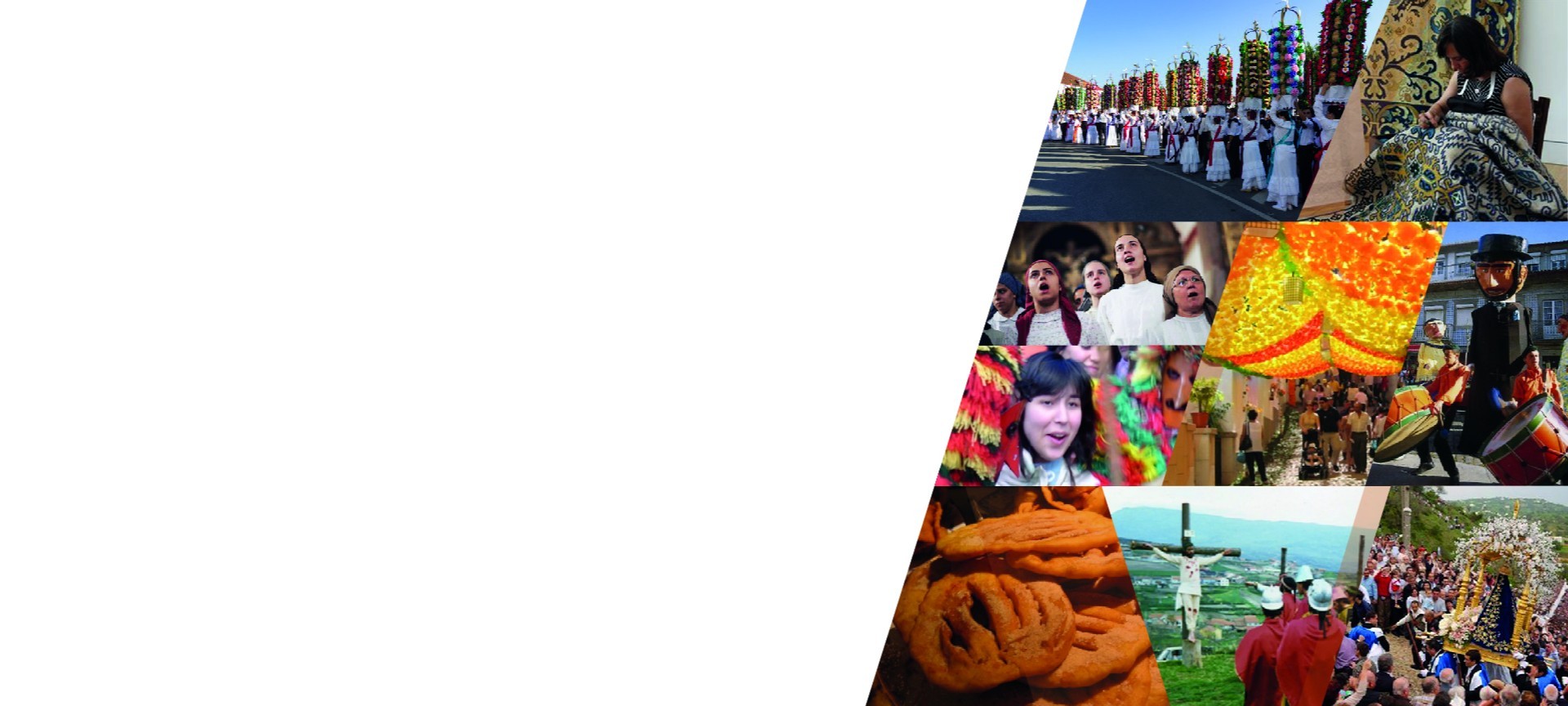
Postgraduation Intangible Cultural Heritage
This training essentially deals with understanding and acting at the level of Intangible Cultural Heritage (ICH), generically taking into account both its incidence in areas such as `oral traditions and expressions, performing arts, social practices, ritua Read more
Course formatOnline
Hours120h
Credits20 ECTS
-
15ª Edição
15ª Edição
Coming SoonStart date 29 Jan, 2027End date 30 Sep, 2027Application start 1 Jun, 2026Application end 27 Jan, 2027
-
What will I learn in this course?
What will I learn in this course?
This training essentially deals with understanding and acting at the level of Intangible Cultural Heritage (ICH), generically taking into account both its incidence in areas such as `oral traditions and expressions, performing arts, social practices, rituals and festive events, knowledge and practices related to nature, skills linked to traditional crafts¿ and the measures aimed at ensuring the viability of its `safeguarding¿ and its very definition: `practices, representations, expressions, knowledge and skills - as well as the instruments, objects, artefacts and cultural spaces associated with them - which communities, groups and, where appropriate, individuals recognise as forming an integral part of their cultural heritage. Intangible cultural heritage, passed down from generation to generation, constantly recreated by communities and groups according to their environment, their interaction with nature and their history, instilling in them a sense of identity and continuity, thus contributing to the promotion of respect for cultural diversity and human creativity¿. COURSE LEARNED IN E-LEARNING FORMAT - you can find information and ways to access the resources and technologies we provide for distance learning and collaboration. Everything is just a CLICK away! at: https://www.ulusofona.pt/click
-
Entry requirements and conditions
Entry requirements and conditions
-
Technical and professional skills that I will acquire
Technical and professional skills that I will acquire
It aims to build a theoretical and methodological framework that will enable technicians, teachers, researchers, animators, programmers, local elected officials, etc., to understand the different dimensions and variants of intangible cultural heritage, as well as to support forms of action that are in line with both the specific nature of intangible heritage and the `Convention for the Safeguarding of the Intangible Cultural Heritage¿ (UNESCO, 2003). Specific objectives: a. Understand the concept of intangible cultural heritage and cultural heritage; b. Identify typologies and apprehend specificities of ICH in different contexts; c. Provide operational tools for defining ICH safeguarding strategies; d. Criticise changes in the concept of intangible cultural heritage in the light of the development of societies and legislative developments; e. Introduce and problematise the concept of ICH in the context of museums; f. Present the theoretical framework on museums and ICH; g. Analyse good practices for safeguarding ICH; h. Acquire skills in identifying, surveying, inventorying, recording, collecting, preserving and disseminating intangible cultural heritage; i. Expand methodological skills to update knowledge; j. Carry out autonomous research; k. Apply the knowledge acquired to `case studies¿; l. Draw up itineraries of intangible cultural heritage; m. Adapt intangible cultural heritage itineraries to the specific needs of specific groups; n. Joining heritage promotion and valorisation working groups.
-
Program
Program
- [Anual]
-
Anthropological Approaches to Intangible Cultural Heritage
2 ects -
Ethnomusicology - Traditional Music, Fieldwork and Inventory Methodology
2 ects -
Folklore and Folklorization
1.5 ects -
History and Theory of Cultural Heritage
2 ects -
Intangible Cultural Heritage Inventory Methodology
1.5 ects -
Introduction to Intangible Cultural Heritage
2 ects -
Knowing - Doing - Traditional Crafts
1.5 ects -
Museums and Intangible Cultural Heritage
1.5 ects -
Popular Medicine - Traditional Curative and Preventive Practices
1 ects -
Sociology of Communities and Popular Religiosity
1.5 ects -
Traditional food
1 ects -
Traditional Oral Literature
1.5 ects -
Traditional Theatricalities and Performances
1 ects
-
Invited Teachers
Invited Teachers
INTANGIBLE CULTURAL HERITAGE - INTRODUCTION - Luís Marques - PhD SOCIOLOGY OF COMMUNITIES AND POPULAR RELIGIOSITY - Paulo Mendes Pinto - PhD HISTORY AND THEORY OF CULTURAL HERITAGE - Ana Cristina Martins - PhD PCI INVENTORY METHODOLOGY - Clara Bertrand Cabral - PhD FOLKLORE AND FOLKLORISATION - Rui Marques - PhD ANTHROPOLOGICAL APPROACHES TO THE PCI - Clara Saraiva - PhD FOLK MEDICINE - TRADITIONAL CURATIVE AND PREVENTIVE PRACTICES - A. Vermelho Corral - Master TRADITIONAL ORAL LITERATURE - Ana Morão - PhD - Alexandre Parafita - PhD TRADITIONAL FOOD - Carmen Soares - Doctor KNOW-HOW. TRADITIONAL HANDICRAFTS - Teresa Perdigão (Master) TRADITIONAL THEATRICALITIES AND PERFORMANCES - Ricardo Seiça - PhD ETHNOMUSICOLOGY - TRADITIONAL MUSIC - FIELDWORK METHODOLOGY AND INVENTORYING - José Alberto Sardinha - Graduate MUSEUMS AND THE PCI - Jean-Yves Durand - PhD
-
Career opportunities and career prospects
Career opportunities and career prospects
This course aims to respond to the lack of scientific-technical training currently faced by directors, curators, senior technicians and various employees of national museums, museums included in the Portuguese Museum Network and municipal museums; councillors, directors, heads of department or division, as well as other senior technicians and employees of local authorities; directors, senior technicians and some technical staff from the various tourism services, not forgetting teachers and students from higher education courses in cultural heritage; associations for the defence of cultural heritage, leaders of ethnographic and folkloric groups, students and other people interested in safeguarding and enhancing intangible cultural heritage.
-
Scientific areas of the course
Scientific areas of the course
Sociologia e outros estudos
Lisboa | F. Ciências Sociais, Educação e Adm.









