


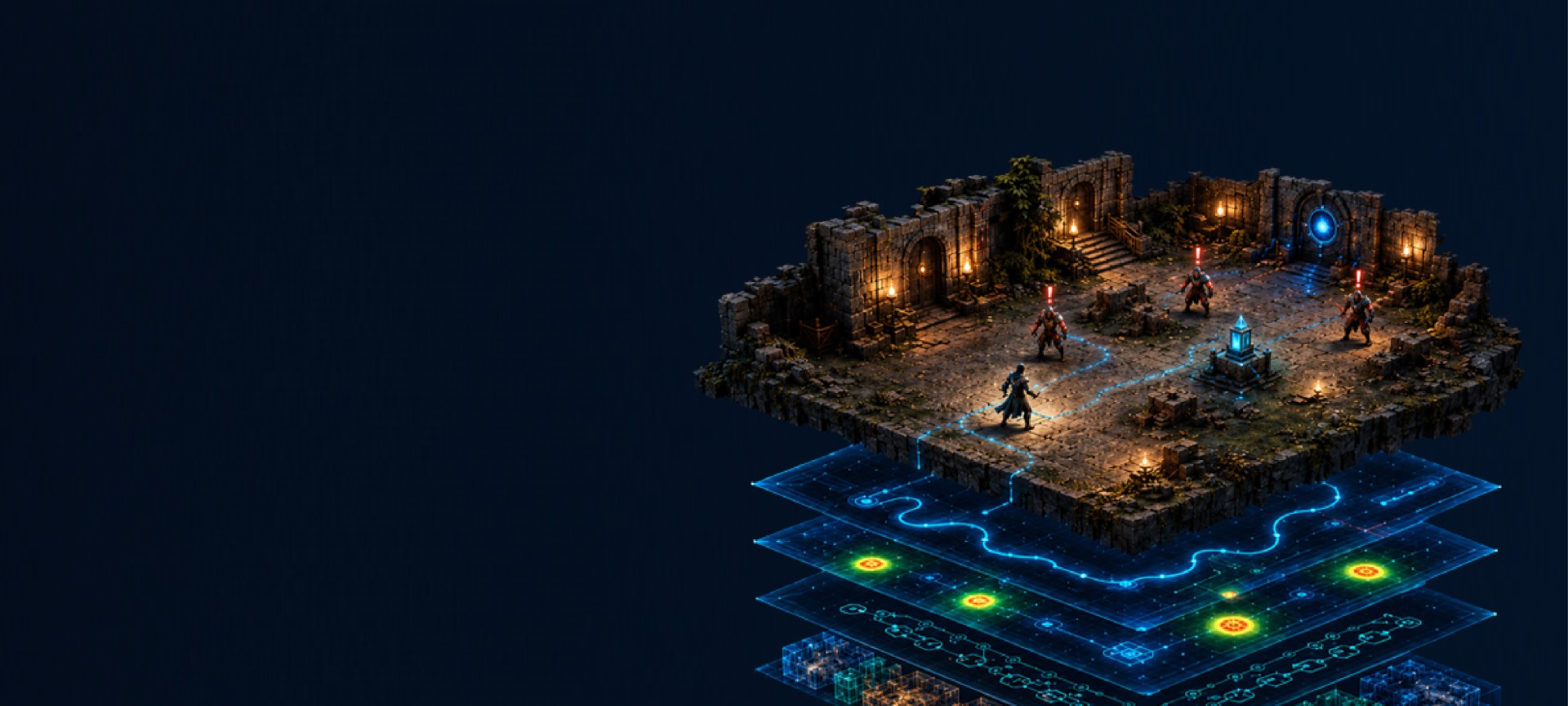
Masters Artificial Intelligence for Games
With over 20 years of established experience, the School of Communication, Architecture, Arts and Technologies (ECATI) at Universidade Lusófona is recognized for its high graduate employability, with alumni working in leading roles in Portugal and internat Read more

You can now choose to study at your own pace and complete your master’s or doctoral degree on either a full-time or part-time basis.
This option is available for master’s and doctoral programmes worth 90 ECTS credits or more.
Tuition fees are calculated according to the number of ECTS credits in which you enrol.
Please refer to Article 16 of the Academic Regulations or contact the relevant services for further information.
Course formatIn-Person
DegreeMasters
Semesters4
Credits120
-
What will I learn in this course?
What will I learn in this course?
With over 20 years of established experience, the School of Communication, Architecture, Arts and Technologies (ECATI) at Universidade Lusófona is recognized for its high graduate employability, with alumni working in leading roles in Portugal and internationally. Beyond academic training, ECATI promotes a practice-based, real-world learning environment built on Learning by Doing, helping students develop strong technical and creative skills. The Master¿s in Artificial Intelligence for Games (Game AI) focuses on the development and application of Artificial Intelligence (AI) techniques and algorithms for video games and interactive systems, in both academic and industry contexts. The program covers AI across key areas such as Human-Computer Interaction (HCI), Game Design, Computer Graphics, and Data Science, including 2D/3D interactive applications, AR/VR (augmented and virtual reality), digital cinematography, usability, and graphical user interfaces (GUI), with a strong focus on real production pipelines and commercial game development. Why Choose This Program? CILECT Network: Part of the prestigious global CILECT network and the only program in Portugal funded by the EU Creative Europe MEDIA programme. Equipment: Access to the largest and most advanced film and audiovisual technology facilities in the Iberian Peninsula. A3ES Accreditation: Registration R/A-Cr 123/2023 (https://si.a3es.pt/sia3es/page?stage=ConsultaPublicaProcesso&processID=449) International Game AI Network: Faculty connected to leading communities such as Foundations of Digital Games (FDG) and the IEEE Computational Intelligence Society (CIS). Industry Partnerships: Active collaborations with Studio Elipsis, FunPlus, RedCatPig, GamingHub, Battlesheep, Codfish, Camel 101, APVP, and others.
-
Entry requirements and conditions
Entry requirements and conditions
The following are eligible to apply: a) Holders of a Bachelor's degree or legal equivalent awarded by a national higher education institution in the areas of "Computer Science" and other related areas; b) Holders of a foreign higher academic degree, or legal equivalent, awarded following a 1st cycle of studies organized in accordance with the principles of the Bologna Process by a State adhering to this Process, in the areas of "Computer Sciences" and other related areas; c) Holders of a foreign higher academic degree, which is recognized by the Scientific Council as satisfying the objectives of the Bachelor's degree in the areas of "Computer Sciences" or in related areas; d) Holders of an academic, scientific or professional curriculum recognized by the Scientific Council as attesting to their ability to complete this cycle of studies.
-
Seriation Criteria
Seriation Criteria
- 25% - Mestrado - Habilitação Anterior
- 75% - Mestrado - Entrevista e Avaliação curricular/portefólio
Candidatos sem habilitação anterior
- 100% - Mestrado - Entrevista
-
Profile of the candidates for whom the course is intended
Profile of the candidates for whom the course is intended
The Master's in Artificial Intelligence for Games (Game AI), offered by the Centro Universitário de Lisboa of Universidade Lusófona, is designed for candidates with a technical background who want to apply Artificial Intelligence (AI) to video game development and interactive systems, with direct relevance to both academic research and industry challenges. The program is especially suitable for: - Graduates in Game Development, Computer Engineering, Mathematics, Statistics, Data Science, and related fields who want to build advanced skills in AI applied to games. - Students and professionals interested in core Game AI topics, including machine learning, reinforcement learning, planning, rule-based systems, behavior trees, player modeling, adaptation and personalization (DDA), and procedural content generation (PCG). - Candidates able to work in teams on practical and experimental projects, with the potential to develop prototypes, technical reports, and results applicable to both the video game industry and research. - Profiles with interests in related areas such as Human-Computer Interaction (HCI), computer graphics, usability, XR/AR/VR, and 2D/3D interactive application development, connected to real production pipelines and interactive experiences.
-
Technical and professional skills that I will acquire
Technical and professional skills that I will acquire
The Master's in Artificial Intelligence for Games (Game AI) develops professional skills in applied AI with direct relevance to the video game industry and strong transferability to other Artificial Intelligence domains: - Intelligent Agents and Game Behavior: Design and implementation of NPCs and autonomous agents (AI as player, opponent, or assistant), using rule-based systems, machine learning, and reinforcement learning. - Procedural Content Generation (PCG): Development of systems to generate levels, missions, items, and content variations, helping increase replayability and improve production efficiency. - Player Analytics and Personalization: Collection and analysis of player data, player modeling, and automatic adaptation (DDA - Dynamic Difficulty Adjustment) to support balancing, usability, and improved player experience. - Transferable AI Skills: Competencies in modeling, prototyping, evaluation, and integration of intelligent systems, applicable beyond games to areas such as robotics, simulation, optimization, recommender systems, HCI, and XR/AR/VR, with a focus on AI ethics and best practices.
-
Main reasons for choosing this course on ULusófona
Main reasons for choosing this course on ULusófona
- Specialisation in a Growing Industry: The video games industry is growing rapidly and relies heavily on innovative AI algorithms to keep up with this exponential development.
- Innovation and Creativity: AI is revolutionising game design, allowing creators to design more immersive, intelligent and dynamic game worlds.
- Competitive advantage: The video games industry is highly competitive. Having a master's degree specialising in AI for video games will set you apart from other candidates, making you more attractive to potential employers.
- Versatility: AI skills are transferable to various areas. Although the focus is on video games, the knowledge acquired in this programme can also be applied to fields such as robotics, data science and computer vision.
- Academic and Industrial Connections: This master's programme has strong links with various R&D institutions in industry and academia, offering plenty of opportunities to create connections with various national and international institutions.
- Multidisciplinary Collaboration: By attending this master's programme, you will have the opportunity to work on interdisciplinary projects with professionals with a variety of skills, such as programmers, graphic artists, game designers and psychologists.
-
Study plan and curriculum structure
Study plan and curriculum structure
-
1º Ano / Common Core
- [1º Semestre]
-
Autonomous Agent Systems
6 ects -
Machine Learning Fundamentals
10 ects -
Player Data Processing
8 ects -
Specialization Workshops I
6 ects
- [2º Semestre]
-
Player Experience Modelling
10 ects -
Procedural Content Generations
10 ects -
Research Methodologies and Games
4 ects -
Specialization Workshops II
6 ects
-
2º Ano / Common Core
- [Anual]
-
Dissertation
50 ects
- [1º Semestre]
-
Autonomous Game Adaptation
6 ects -
Specialization Workshops III
4 ects
-
1º Ano / Common Core
-
Course Team
Course Team
-
Invited Teachers
Invited Teachers
Dr. Antonios Liapis (Assistant Professor / University of Malta) Xalavier Nelson Jr. (Creative Director / Strange Scaffold) Dr. David Melhart (AI Researcher / modl.ai) Dr. Renata Ntelia (Assistant Professor / University of Lincoln) Dr. Pippin Barr (Assistant Professor / Concordia University) Diogo de Andrade (Independent Game Programmer) Geraldo Nascimento (Senior Lead Programmer / Lively - A Keywords Studio)
-
Career opportunities and career prospects
Career opportunities and career prospects
The Master's in Artificial Intelligence for Games (Game AI) prepares students to work in multidisciplinary teams in the video game industry and in Research and Development (R&D), in roles that require knowledge of Artificial Intelligence (AI), autonomous agents, machine learning, data science, and data analytics. Typical career paths include: - AI Programmer: Implements NPC and agent behavior (e.g., behavior trees, planning, decision-making), integrates AI systems into game engines, and optimizes runtime performance. - Gameplay Engineer: Develops and tunes gameplay systems supported by AI (balancing, adaptive systems, agent interaction), ensuring robustness and integration with the overall game architecture. - Gameplay Analyst: Analyzes telemetry and player behavior (player analytics), identifies retention and difficulty patterns, and supports game design decisions through data and experimentation. - Data Scientist: Builds data pipelines, statistical models, forecasts, metrics, dashboards, and analytics models that support game product, design, and live operations. - Machine Learning Engineer: Trains, evaluates, and deploys ML models (including reinforcement learning when relevant), with a focus on performance, monitoring, and integration in interactive products. - UI/UX Analyst: Studies usability and Human-Computer Interaction (HCI), tests interfaces, analyzes qualitative and quantitative data, and proposes evidence-based improvements. - Marketing Analyst: Uses data analytics for segmentation, campaigns, LTV/retention analysis, and acquisition optimization, connecting product metrics with marketing strategy. - Research & Development (R&D): Prototypes new AI approaches for games, validates them through experimental methods, and publishes or transfers technology to product teams. Transferability Beyond Games Skills in AI, machine learning, autonomous agents, optimization, and data analytics are highly transferable beyond games to sectors that use intelligent systems and data, including robotics and autonomous systems, simulation, recommender systems and personalization, digital health, fintech, Industry 4.0, mobility, HCI, and XR/AR/VR.
-
What master's or postgraduate degrees can I pursue afterward?
What master's or postgraduate degrees can I pursue afterward?
Doctoral programs Specialization courses in Games Continuation of applied studies in research centers
-
Infrastructure and Equipment
Infrastructure and Equipment
The Games Department provides students with specialized facilities and equipment for video game development, Artificial Intelligence for Games (Game AI), XR (VR/AR), playtesting, data collection, prototyping, and applied research. These resources support hands-on work in an industry-relevant environment, including academic projects, interactive production, and R&D (Research and Development) activities. Technology Highlights - Motion Capture Studio (MoCap): Motion capture for animation, interaction, and immersive experiences in games and XR. - Soundproof Labs: Dedicated spaces for playtesting, controlled observation, telemetry, player analytics, usability testing, and HCI studies. - Renovated Classrooms with Laptops: Support for programming, prototyping, data analysis, and collaborative project work. - XR Equipment (VR/AR): Access to Varjo, Valve Index, Meta Quest 2, and Meta Quest 3 for developing and testing immersive interactive experiences. - LED Wall Studio: Facilities for virtual production, interactive prototyping, and integration with XR and game development pipelines. - Sound Studio: Audio recording, editing, and sound design for games and multimedia projects.
-
Scientific areas of the course
Scientific areas of the course
Ciências, matemática e informática
-
Research
Research
Despite the numerous links within the videogame industry and a vast participation of guests within the sector, the teaching staff also encourages work within the field of research and development of game technology, taking advantage of the wide range of available research centers at Lusófona University, with emphasis on the following: - Hei-Lab - https://hei-lab.ulusofona.pt/ - CICANT - https://cicant.ulusofona.pt/ - COPLABS - http://copelabs.ulusofona.pt/
-
Observations
Observations
After Work (Monday to Thursday from 18h30-22h00)
Lisboa | Esc.Comunicação, Arquitetura, Artes e TI
Current Application Dates
Fees
Course Direction
Course Subdirection
Secretariat
-
Telephone extension766
-
LocationSala F.1.15.3
-
Service hours2ªf a 6ªf - 11h às 13h e das 14h às 16h
Agência de Avaliação e Acreditação do Ensino Superior
Graduation Requirements
Have completed a total of 120 ECTS.
Related Content
Partners




Mobility for Students and Academic Staff
Taking part in a mobility programme is the perfect opportunity to broaden your horizons through a rich cultural, academic and personal experience.
Learn more
Learn more









