


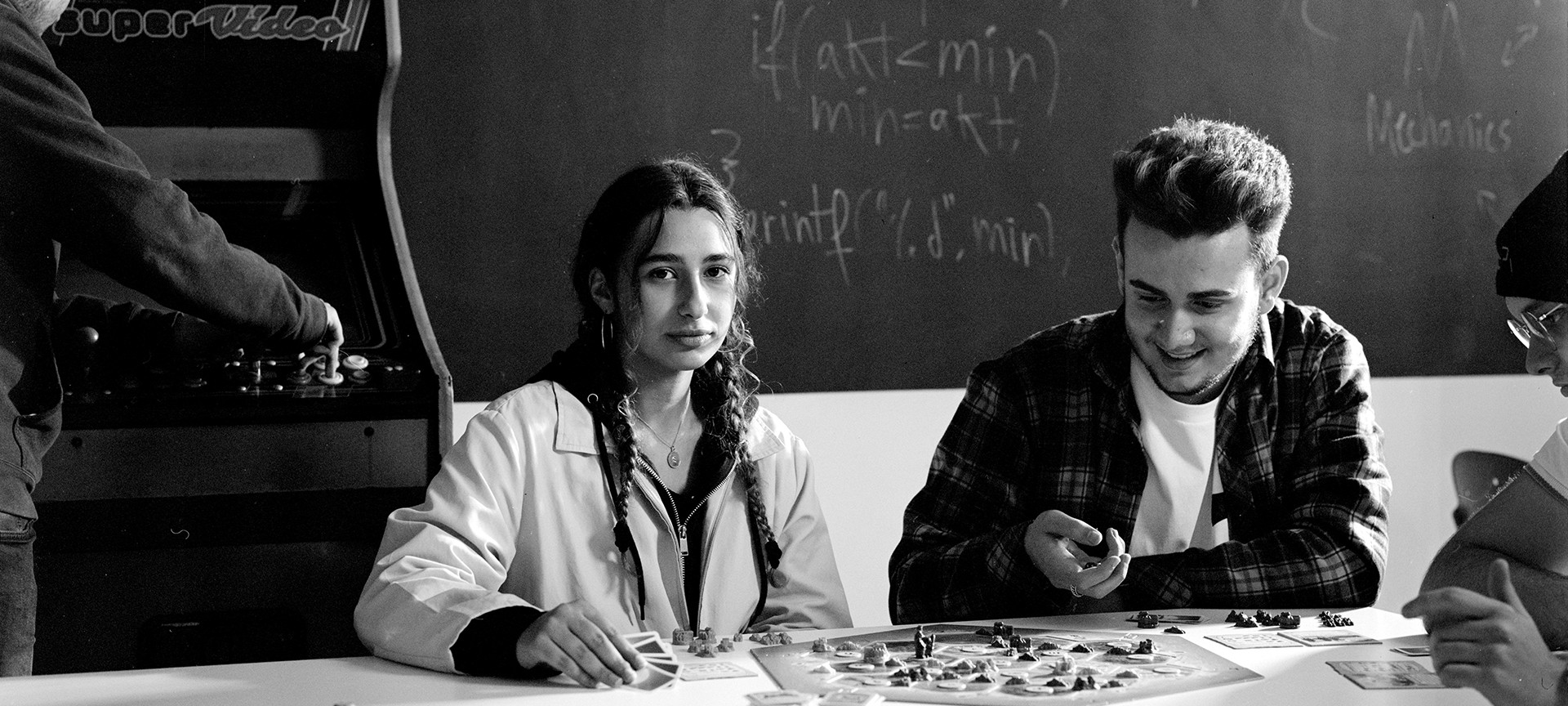
Bachelor Videogames
The degree in Video Games at Universidade Lusófona aims to offer theoretical and practical training, specialized and professionalizing, of technological and artistic nature, in the areas of Video Games, Game Design, Game Programming, Game Art, Board Games, Read more

Course formatIn-Person
DegreeBachelor
Semesters6
Credits180
-
What will I learn in this course?
What will I learn in this course?
The degree in Video Games at Universidade Lusófona aims to offer theoretical and practical training, specialized and professionalizing, of technological and artistic nature, in the areas of Video Games, Game Design, Game Programming, Game Art, Board Games, Hybrid Games, Serious Games, AR, VR, AI, 3D Animation and Modeling, multimedia communication and interactive arts. As part of the Department of Film and Media Arts on the campus of Lusófona University in Lisbon, our students enjoy unique facilities in Portugal through access to laboratories, technological resources, proximity to both industry and research, and the opportunity to access an international network of partner universities in this department. Our goal is for Video Game students at Universidade Lusófona to have the opportunity to express themselves through their games, whether critical, conceptual or experimental, and therefore become important agents for the creative and cultural production of this sector. Game creation is an activity that requires truly interdisciplinary professionals, and that is the focus of our curriculum. Video games are ¿learned by doing¿, during the course our students develop practical skills in the areas of Game Design, Game Art and Programming, contact with experienced professionals, have access to technologies such as VR, AR and MOCAP and also the possibility to participate in events where they test their knowledge among peers, expanding their network of contacts.
-
Entry requirements and conditions
Entry requirements and conditions
Those who apply through the institutional admission process may apply for this study program. See the required exams below.- 03 Desenho
- and
or- 18 Português
- and
or- 03 Desenho
- and
- 16 Matemática
- and
or- 03 Desenho
- and
- 18 Português
- and
or- 16 Matemática
- and
- 18 Português
- and
or- 06 Filosofia
- and
- 17 Matemática Aplicada às Ciências Sociais
- and
or- 13 Inglês
- and
- 17 Matemática Aplicada às Ciências Sociais
- and
or- 10 Geometria Descritiva
- and
- 16 Matemática
- and
Candidates may also apply via the regimes of institution/programme transfer or via Special Application, in accordance with the legal regulations in force (holders of higher education degree, holders of a Technological Specialization Course, holders of Professional Higher Technician Course or Over 23 years of Age). Candidates who meet the requirements defined in the International Student Statute can also apply.
-
Profile of the candidates for whom the course is intended
Profile of the candidates for whom the course is intended
Para todos os candidatos a ensino superior que sonhem com uma actividade profissional ligada às indústrias criativas das aplicações multimédia e videojogos e que estejam disponíveis para trabalho árduo com muita paixão. EN For all higher education candidates who dream of a career in the creative industries of multimedia applications and video games and who are available for hard work with a lot of passion.
-
Technical and professional skills that I will acquire
Technical and professional skills that I will acquire
Competences to be acquired: - Conceive and write interactive fictions and narratives for digital games; -Create virtual architectures and platforms, taking advantage of social programmes and entertainment spaces; -Design and produce games (Game Design and Game Art) or, alternatively, program games (Programming); - Learn to create and produce games with different technical typologies (computer, VR, AR, console, mobile, boardgames, performative or networked); -Create and produce entertainment systems for multiple participants that combine online and offline game types; -Develop virtual communities from social systems attached to digital games; -Use 3D modelling and animation; -Program for Mobile Applications and different game consoles; - Programming procedural generation and AI for games; -Conceptually develop and produce storyboards, and write projects; -Promote and distribute entertainment products; -Design and manage multimedia projects.
-
Study plan and curriculum structure
Study plan and curriculum structure
-
1º Ano / General path
- [1º Semestre]
-
Game Art I
6 ects -
Game Design I
4 ects -
History of Games and Interfaces
4 ects -
Introduction to Computing
6 ects -
Introduction to Mathematics and Physics for Games I
4 ects -
Programming Fundamentals
6 ects
- [2º Semestre]
-
Digital Game Development I
6 ects -
Introduction to Mathematics and Physics for Games II
4 ects -
Game Art II
6 ects -
Game Design II
4 ects -
Programming Languages I
6 ects -
Visual Culture
4 ects
-
2º Ano / General path
- [1º Semestre]
-
Cinema, Art, and Culture
4 ects -
Digital Game Development II
6 ects -
Game Design III
4 ects -
Sound Design I
4 ects
- [2º Semestre]
-
Applied Games I
4 ects -
Argument and Interactive Narratives
4 ects -
Digital Game Development III
6 ects -
Games with Alternative Interfaces
4 ects
- [Semestral]
- Option I
- Option II
- Option III
- Option IV
-
3º Ano / General path
- [1º Semestre]
-
Applied Games II
6 ects -
Entertainment Systems
4 ects -
Project Management and Planning
4 ects -
Project Workshop I
8 ects - Option V
- [2º Semestre]
-
Advertising and Marketing Workshop
4 ects -
Expanded Realities XR
4 ects -
Project Workshop II
8 ects -
Traineeship Seminar
14 ects
- [Semestral]
- Option VI
-
1º Ano / General path
-
Options
Options
-
Option I
- Animation and Modeling 3D I (Option I)
6 ects - Animation and Modeling 3D II (Option I)
6 ects - Art and Environment Creation (Option I)
6 ects - Artificial Intelligence (Option I)
6 ects - Character Design and Motion Capture (Option I)
6 ects - Conflict Theory: Management, Prevention, Resolution and Transformation (Option I)
6 ects - Graphic Computing (Option I)
6 ects - Network Systems for Games (Option I)
6 ects - Programming Languages II (Option I)
6 ects
- Animation and Modeling 3D I (Option I)
-
Option II
- Animation and Modeling 3D I (Option II)
6 ects - Animation and Modeling 3D II (Option II)
6 ects - Art and Environment Creation (Option II)
6 ects - Character Design and Motion Capture (Option II)
6 ects - Graphic Computing (Option II)
6 ects - Network Systems for Games (Option II)
6 ects - Programming Languages II (Option II)
6 ects
- Animation and Modeling 3D I (Option II)
-
Option III
- Animation and Modeling 3D I (Option III)
6 ects - Animation and Modeling 3D II (Option III)
6 ects - Art and Environment Creation (Option III)
6 ects - Artificial Intelligence (Option III)
6 ects - Character Design and Motion Capture (Option III)
6 ects - Graphic Computing (Option III)
6 ects - Network Systems for Games (Option III)
6 ects
- Animation and Modeling 3D I (Option III)
-
Option IV
- Programming Languages II (Option IV)
6 ects - Animation and Modeling 3D I (Option IV)
6 ects - Animation and Modeling 3D II (Option IV)
6 ects - Art and Environment Creation (Option IV)
6 ects - Artificial Intelligence (Option IV)
6 ects - Character Design and Motion Capture (Option IV)
6 ects - Graphic Computing (Option IV)
6 ects - Network Systems for Games (Option IV)
6 ects
- Programming Languages II (Option IV)
-
Option V
- Digital Systems (Option V)
6 ects - Operating Systems (Option V)
6 ects
- Digital Systems (Option V)
-
Option VI
- Animation and Modeling 3D I (Option VI)
6 ects - Art and Environment Creation (Option VI)
6 ects - Concept Art (Option VI)
4 ects - Digital Painting (Option VI)
4 ects - Operating Systems (Option VI)
6 ects - Computer Security (Option VI)
5 ects - Film History and Theory (Option VI)
4 ects - Graphic Computing (Option VI)
6 ects
- Animation and Modeling 3D I (Option VI)
-
Option I
-
Course Team
Course Team
-
Career opportunities and career prospects
Career opportunities and career prospects
- Game development in a business context; - Design of Apps, interfaces and information systems for multimedia platforms (web, offline, mobile, blogs, etc.); - Games applied to advertising and marketing projects (advergames and alternate reality games); - Serious games and gamification (ludic systems applied to other areas of knowledge); - Game development for social networks, companies, urban and inclusive projects in the scope of festivals for municipalities, museums and other cultural, institutional and commercial events; - 2d and 3d modeling for video games, VR, XR, AR, Animation, Architecture and Cinema. - Creation of Interactive Applications that take advantage of ludic systems: interactive storefronts, reactive carpets, tactile projects for mobile devices, among others; - Conception and management of multimedia projects involving large production teams (designers, artists, programmers, scriptwriters, producers, etc.) and various technologies (computer networks, cell phones, video, augmented reality, printing of graphic elements on paper, among other possibilities). - "Game changer": Game designer, Conceptual development, and multimedia project design;
-
What master's or postgraduate degrees can I pursue afterward?
What master's or postgraduate degrees can I pursue afterward?
The 1st Cycle degree in Video Games opens the way to the 2nd Cycle degree offer of the School of Communication, Architecture, Arts and Information Technology, namely the Master in Game Design and Playable Media.
-
Invited Teachers
Invited Teachers
EN Every academic year we invite lecturers/experts to teach modules, masterclasses or workshops related to the creative industry of video games. Whether Game Dev Meets, Game Talks, Pitching Sessions or specific conferences, guest lecturers are often present. In each semester there are two weeks of workshops and masterclasses in which students interact with guests from the gaming and entertainment industry and researchers. In face-to-face or online format, the sharing of up-to-date knowledge by these participants is one of the strengths of this teaching proposal.
-
Infrastructure and Equipment
Infrastructure and Equipment
Universidade Lusófona possesses one of the best sets of audiovisual and multimedia equipments and labs in the country for training purposes. Special reference must be made to the MOCAP studio, the HD tv and film studios, the AVID development centre, the 3d animation labs, the post-production facilities, the interactive applications lab and the virtual sets labs. Besides these facilities, this course will also use several labs targeted at development and multimedia creation both using PC and MAC based platforms.
-
Scientific areas of the course
Scientific areas of the course
Áudio-visuais e produção dos media
-
Research
Research
A licenciatura em Videojogos interage com as unidades de investigação Hei-Lab, CEeid e Cicant para o desenvolvimento de vários projectos Erasmus+, FCT, Fazer+, entre outros, nos quais os alunos realizam trabalho no campo expandido dos jogos em ambiente curricular ou através de bolsas de estudo. Jogos Sérios, Jogos educativos, simuladores VR e aplicações AR são algumas das aplicações desenvolvidas que têm contribuído para a criação de emprego e incentivado o progresso dos alunos para ensino de 2º ciclo, através das bolsas disponibilizadas pelos nossos centros de investigação. A possibilidade de estudos avançados no Curso de Mestrado em Design de Jogos e Média Jogáveis é uma realidade e uma proposta aliciante para quem pretende se especializar num nível de 2º ciclo.
-
Observations
Observations
The undergraduate programme in Multimedia Applications and Videogames will work in close relation with the labour market and there is a constant concern with adapting contents taught to the industry¿s reality and needs. Thus, in the 2nd semester of the last year, students will have to rake the 10 ECTS corresponding to the subject Professional Project and Integration Seminar by taking an internship (20 contact hours) in a company in the sector close to the field of expertise of this 1st cycle degree. It must be pointed out that Universidade Lusófona has signed various protocols with relevant entities in the audiovisual and multimedia industries, both in Portugal and in the rest of Europe. In this way we expect to broaden the provision in markets so receptive to change and characterized by technological evolution such as these. The above mentioned protocols cover diversified areas, and with them several goals will be achieved: integrating students in professional internships in companies, integrating instructors from state-of-the-art technological areas, and sharing resources and know-how. In accordance with Portaria nº 256/2005, 16 de Março, this course is inscribed in area 213 - Audiovisuals and media production.
Lisboa | Esc.Comunicação, Arquitetura, Artes e TI
Current Application Dates
Fees
Course Direction
Course Subdirection
Secretariat
-
Telephone extension686
-
LocationSala F.1.15.3
-
Service hours2ªf a 6ªf - 9h às 13h e das 14h às 16h
Agência de Avaliação e Acreditação do Ensino Superior
Graduation Requirements
Have completed a total of 180 ECTS.
Related Content
Mobility for Students and Academic Staff
Taking part in a mobility programme is the perfect opportunity to broaden your horizons through a rich cultural, academic and personal experience.
Learn more
Learn more









